

Hiring a new employee is only the beginning.
Before that employee can contribute confidently, the company may need to collect payroll information, tax documents, certifications, emergency contacts and company acknowledgements. Managers may also need to confirm that training, equipment, site access and other job-readiness requirements have been completed.
For many construction companies, these steps are managed through a combination of emails, paper forms, spreadsheets, shared folders and verbal follow-ups. HR may have one checklist, payroll may be waiting for separate information and the employee’s manager may not know which requirements are still outstanding.
That creates a familiar problem - everyone understands that onboarding needs to happen, but no one has a complete, current view of whether it has actually been completed.
A better employee onboarding process gives each new hire a structured path to follow. It standardizes how information is collected, makes outstanding requirements easier to identify and gives HR and managers a shared view of progress.
Why Employee Onboarding Becomes Hard to Manage
Employee onboarding often starts with a checklist.
HR sends the new hire a group of documents, asks them to return the completed forms and begins setting up their employee profile. Payroll waits for banking and tax information. A manager handles job-specific requirements, while someone else may be responsible for training records, certifications, PPE or site access.
That process can work when a company hires occasionally and the same person manages every step. As hiring volume increases, however, the number of handoffs becomes much harder to control.
Documents arrive through different channels. Some are completed immediately, while others require repeated reminders. Information entered into an intake document may need to be re-entered into an employee record. Managers may assume HR has completed a task, while HR assumes the manager is handling it.
The consequences are rarely limited to administration.
A missing form can delay payroll setup. An expired or unverified certification can affect where an employee can work. A worker may arrive on-site without the information, training or equipment they were expected to receive. HR then has to interrupt other work to determine what was missed and who is responsible for fixing it.
The issue is not simply collecting documents. The real challenge is coordinating every onboarding requirement across several people while keeping the process consistent for every hire.
That is where a structured workflow can help.
A Better Way to Manage New-Hire Onboarding
A connected employee onboarding workflow starts with a consistent intake process.
Instead of collecting initial employee information through separate messages or informal notes, the company can use a standardized New Employee Intake Form. The form creates a clear starting point and ensures that the same foundational information is requested for every new hire.
Once that intake is completed, the Employee Onboarding workflow can create the employee’s user profile and generate a card in an onboarding board. The card becomes the central tracking record for the new hire, while the board gives HR a visual overview of everyone currently moving through onboarding.
From there, required documents can be assigned in sequence. The published workflow includes forms for direct deposit and tax documentation, followed by a final Employee Onboarding Checklist for the employee’s manager. As each stage is completed, the onboarding board can update to reflect the employee’s current status.
This reduces the need for HR to repeatedly ask:
- Has the employee submitted their payroll information?
- Are the required tax documents complete?
- Is anything still waiting for the manager?
- Is the employee ready to move into the final onboarding stage?
Instead of piecing together those answers from emails and individual documents, the team can use the workflow to see where each new hire stands.
Example: How the Workflow Works
The process begins when the company is ready to onboard a new employee.
An HR team member completes the New Employee Intake Form with the employee’s core information. This gives the company a standard record of the details required to begin onboarding.
Submitting that intake form can create the employee’s user profile and add a new card to the Employee Onboarding Board. The new hire is now visible in the onboarding pipeline rather than being tracked through a private checklist or someone’s inbox.
The workflow then assigns the next required documents.
The employee can be guided through direct-deposit information and tax documentation in a defined sequence. Employee information from the original intake can be mapped into subsequent forms, reducing the amount of information that needs to be entered repeatedly.
As requirements are completed, the employee’s card progresses through the onboarding board. A company might organize its process into stages such as:
- Intake started
- Employee profile created
- Payroll information required
- Tax documentation required
- Manager review
- Onboarding complete
The exact stages can be adapted to the company’s process, but their purpose remains the same: make incomplete work visible before it causes a delay.
Once the required employee forms are finished, the final checklist is assigned to the employee’s manager. This provides a last review point for confirming that the employee has completed the required onboarding process.
For construction teams, the process can also be adapted to include additional requirements such as safety training or employee certifications. Ontraccr user profiles support certification records, including acquired dates, expiry dates, issuers and uploaded certification files.
The result is a connected record of onboarding progress rather than a collection of disconnected tasks.
Manual Onboarding vs. a Connected Workflow
A manual onboarding process can appear flexible, but much of that flexibility comes from relying on people to remember the next step.
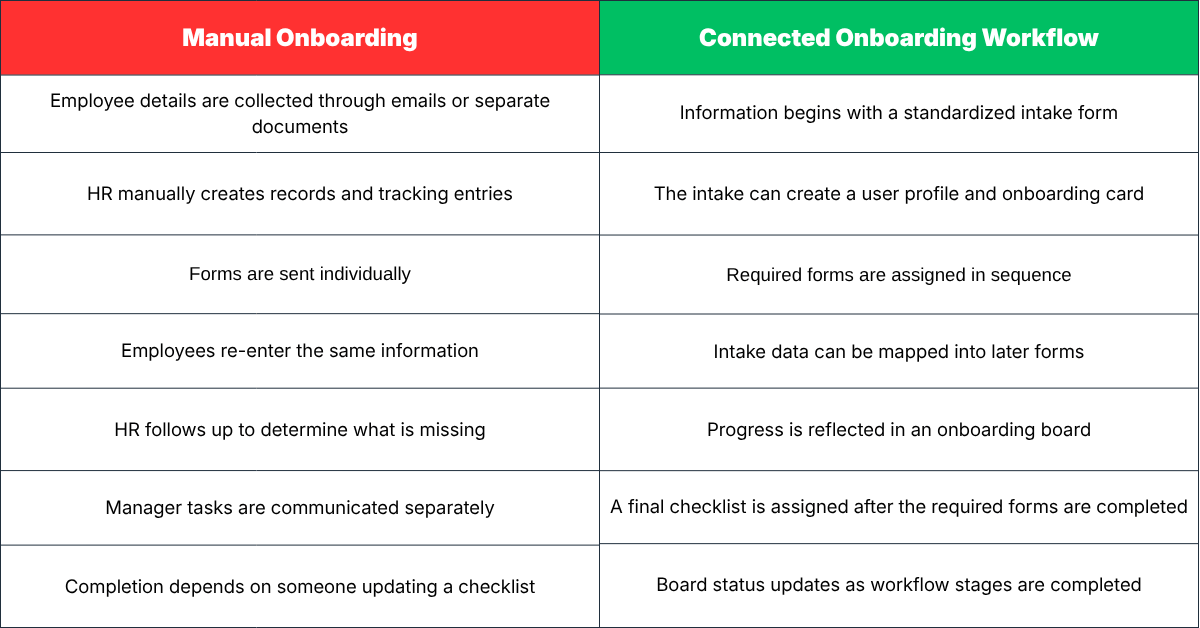
The goal is not to remove the human side of onboarding. New employees still need introductions, support, clear expectations and access to the people who can help them.
The workflow handles the repetitive coordination around that experience so HR and managers can spend less time checking document status and more time helping the employee become part of the team.
Construction Employee Onboarding Process Checklist
Use this free checklist to review how your company handles employee intake, payroll documents, certifications, manager responsibilities and final job-readiness checks.

Why This Matters for Construction Companies
Construction onboarding involves more than administrative paperwork.
Companies need to prepare employees for work that may take place across different crews, projects and locations. Requirements may vary according to the employee’s role, whether they work in the office or field and the type of work they will perform.
A field employee may need safety documentation, certifications, PPE and project-specific information before arriving on-site. An office employee may need a different combination of policies, system access and internal training. A structured workflow gives the company a common foundation while still allowing the process to be adjusted for different employee types.
This becomes especially useful when several employees are being onboarded at once.
Without a centralized view, HR may know that five employees are in progress but still have to open individual folders or conversations to understand what each person is missing. An onboarding board gives the team a visual way to distinguish between employees who have just started, employees waiting on documents and employees nearing completion.
It also makes ownership clearer.
The employee can see the forms assigned to them. HR can see whether required information has been submitted. The manager receives a defined checklist at the appropriate stage. Each person understands what they are responsible for without relying on a chain of forwarded messages.
Who This Workflow Is For
An Employee Onboarding workflow can help construction and field-service companies that need a more repeatable way to bring employees into the organization.
It can be particularly useful for:
- Contractors hiring multiple field employees during busy periods
- Companies onboarding employees across different branches or divisions
- HR teams coordinating requirements with payroll and operations
- Safety teams that need better visibility into employee certifications
- Managers responsible for confirming job or site readiness
- Growing companies moving away from paper forms and informal checklists
Smaller teams can also benefit. Even when only a few people are hired each year, a documented process makes it easier to provide each employee with a consistent experience and reduces the risk of an important step being forgotten.
Customizing the Onboarding Process
No two construction companies have exactly the same onboarding requirements.
Some may only need a short intake, payroll setup and manager review. Others may need several additional steps for safety training, certifications, union information, company policies, equipment assignments or site-specific preparation.
The Employee Onboarding workflow can be customized with conditional forms based on employee type, additional onboarding stages for safety training or certifications and branded PDF outputs.
For example, a company could create separate paths for field and office employees. Both groups might begin with the same intake process, while only field employees receive additional safety or certification requirements.
The onboarding board can also be structured around the stages that matter to the company. The point is not to add more steps. It is to make the necessary steps clear, visible and repeatable.
Where Automation Helps Most
The most valuable parts of onboarding automation are often the small handoffs.
When intake is complete, someone needs to create the employee record. When one document is submitted, someone needs to send the next one. Once the employee has completed their requirements, the manager needs to know it is time to carry out the final review.
Each task is simple on its own. The difficulty comes from completing every step in the correct order for every new employee.
The Employee Onboarding workflow connects these handoffs by creating an employee profile from the intake form and adding a tracking card for the new hire. Required forms can then be assigned in sequence, with employee information carrying into subsequent documents to reduce repeated data entry.
As requirements are completed, the onboarding status can update automatically. Once the employee has finished their assigned steps, the manager checklist can be issued to complete the final stage of the process.
These automations do not replace HR or the employee’s manager. Instead, they help ensure routine coordination does not depend entirely on someone remembering every follow-up, document and status update.
How to Get Started
Start by reviewing how a new employee currently moves from accepted offer to job-ready team member.
Identify every document the employee must complete, every record the company must create and every internal task that must happen before onboarding is considered finished.
Then look for the points where the process becomes unclear:
- Where is employee information first collected?
- Which information is entered more than once?
- Who sends each required document?
- How does HR identify missing requirements?
- When does the manager become involved?
- What determines that onboarding is complete?
- Are certifications and expiry dates recorded consistently?
- Can the company see the status of every active new hire?
Once those gaps are understood, the process can be organized into a clear sequence.
Many companies can begin with the intake form and onboarding board. This creates a standard starting point and a central view of progress. From there, payroll and tax forms can be added, followed by the manager’s final checklist and any role-specific requirements.
The goal is not to introduce more administration. It is to create a process that employees, HR and managers can rely on every time someone joins the company.
Final Thoughts
Employee onboarding should not depend on scattered forms, private checklists or someone remembering to send the next email.
When employee information is collected consistently, requirements are assigned in a clear sequence and progress is visible in one place, the entire process becomes easier to manage.
New employees receive a clearer path through their first requirements. HR spends less time chasing documents. Managers know when their input is needed. The company gains a more reliable way to confirm that each employee is ready to move forward.
A connected Employee Onboarding workflow helps construction teams move from inconsistent follow-up to a structured, repeatable process, from initial intake through final manager review.
Want to see what this looks like in action?
Explore Ontraccr’s Employee Onboarding workflow to see how employee intake, document collection, profile creation and progress tracking can be managed through one connected process.
If you want to discover more you can book a demo walkthrough here -